Taxonomy of Explainability Methods
Three Useful Axes
The lecture organizes explainability methods along three simple axes. This is a helpful way to avoid mixing techniques that answer very different questions.
| Axis | First side | Second side | Main question |
|---|---|---|---|
| Timing | Ante hoc | Post-hoc | Is the model interpretable by design, or explained after training? |
| Scope | Global | Local | Do we want to understand the whole model or one prediction? |
| Dependence | Model-specific | Model-agnostic | Does the method need internal access to the model? |
The slide below is worth keeping because it compresses the full taxonomy into one visual map before we discuss each axis separately.
Ante Hoc vs Post-Hoc
- Ante hoc methods are interpretable by construction. Decision trees and generalized linear models are the main examples in this course.
- Post-hoc methods are applied after a model has already been trained. They aim to summarize or approximate the behavior of a more complex predictor.
Ante hoc explanations are usually cleaner because the model itself is transparent. Post-hoc explanations are more flexible, but they are often approximate.
Global vs Local
- A global explanation tells us how the model behaves overall.
- A local explanation tells us why one particular input received one particular prediction.
These are complementary rather than competing views. A model can look sensible globally while still failing on specific edge cases, and a convincing local explanation does not guarantee that the entire model is well-behaved.
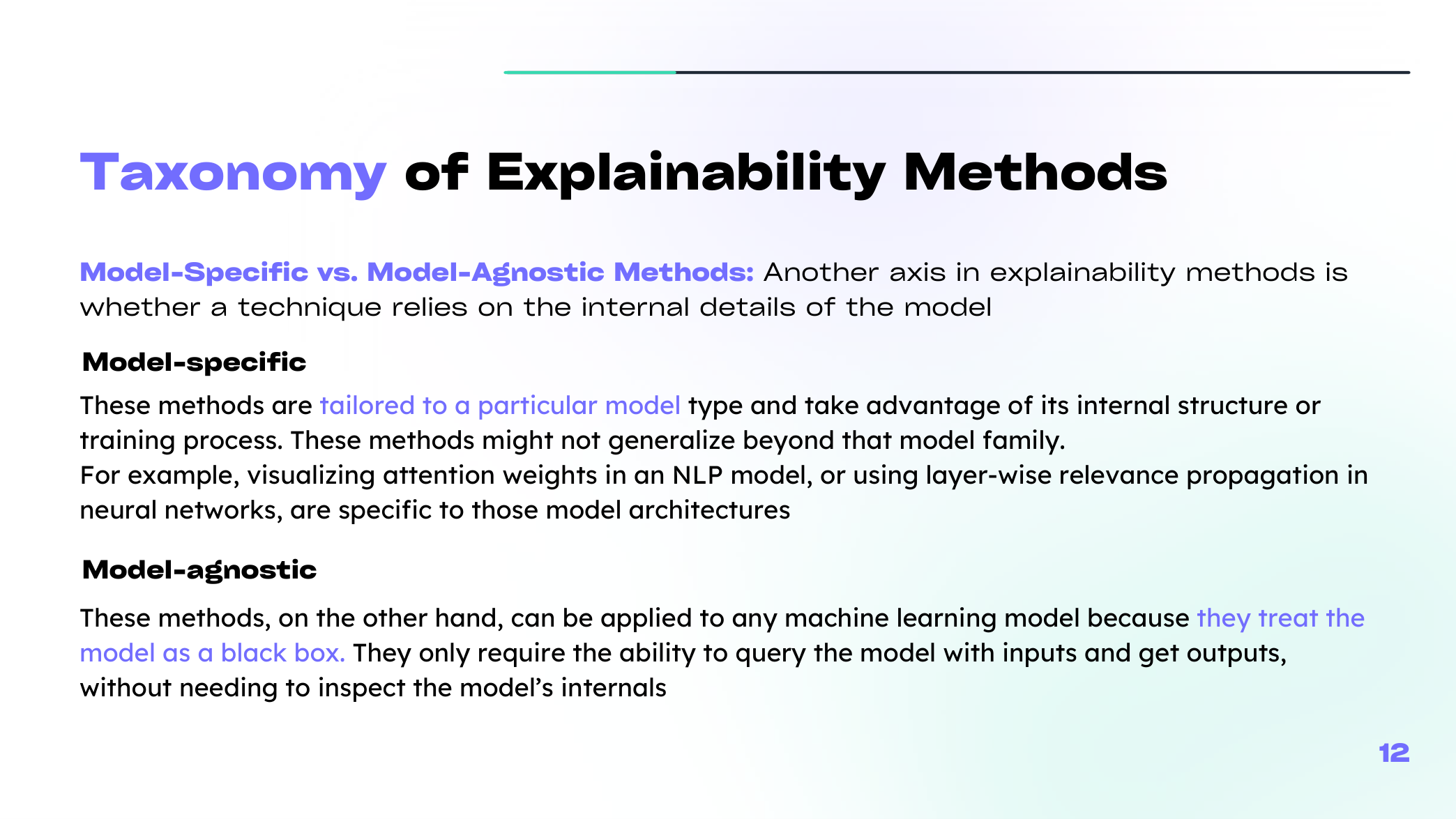
Model-Specific vs Model-Agnostic
- Model-specific methods use internal structure such as trees, gradients, or hidden-layer activations.
- Model-agnostic methods treat the predictor as a black box and only rely on inputs and outputs.
Model-agnostic tools are portable, but they can be slower or less exact. Model-specific tools can be sharper, but only for one model family.
Typical Examples
The categories become easier to remember once we attach a few examples to them.
| Category | Typical methods from this course |
|---|---|
| Ante hoc | Decision trees, GLMs |
| Global post-hoc | Permutation importance, PDP, LOFO, surrogate models |
| Local post-hoc | LIME, SHAP, counterfactuals, anchors |
| Model-specific | Tree importance, TCAV, Grad-CAM, LRP |
Choosing the Right Kind of Explanation
Before applying any method, it helps to ask:
- Do I need to explain the full model or a single decision?
- Can I access the internals of the model?
- Do I need a faithful explanation, a simple approximation, or both?
Once these questions are clear, method selection becomes much easier.
Summary
In this lesson we classified explanations by:
- Ante hoc vs post-hoc
- Global vs local
- Model-specific vs model-agnostic
- The practical question each axis helps answer
Next: We move to intrinsically interpretable models, where the explanation is built into the model itself.